
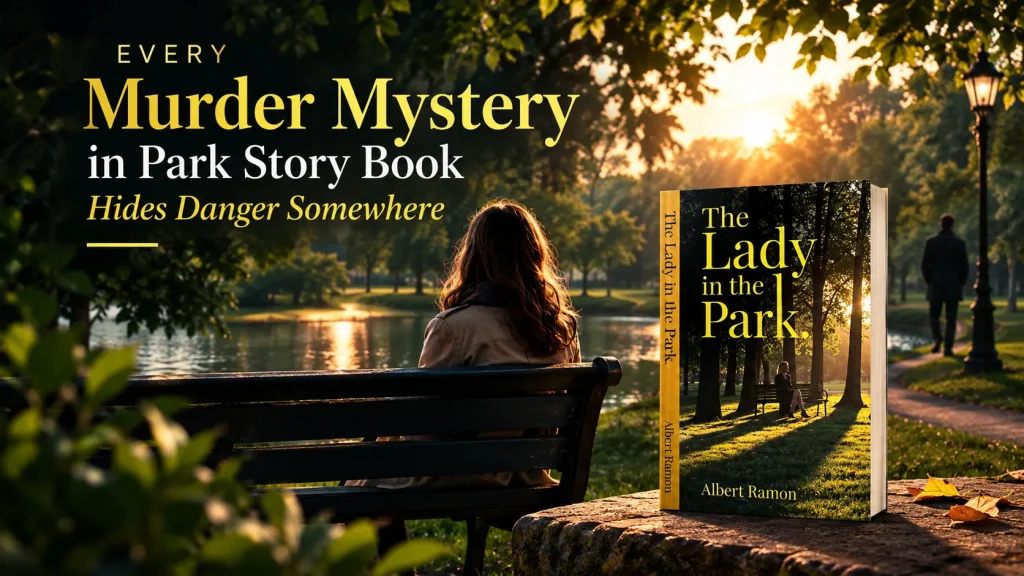
Most thrillers rush toward danger. A body turns up fast. A detective gets a call. But this murder mystery in park story book takes it slow. It opens with one small act of kindness. Then it never quite lets go of that ordinary feeling, and that is why it works so well. So if you have ever helped a stranger without a second thought, this book will make you think twice.
What Sets This Murder Mystery in Park Story Book Apart
There is no crime scene here, not at first. Graham is jogging through his local park after a long day when he spots a young woman alone on a bench. She looks upset. So he stops. That is the whole opening, and somehow it is enough. No weapon shows up. No chase scene either. Instead, the tension builds the way it does in real life: slowly, through small choices that only look risky in hindsight.
A Bench, a Stranger, and the Rest of the Story
The Lady in the Park crime fiction story does not sit still for long. It moves through three settings, and each one raises the stakes a bit more.
The First Meeting
Graham stops because Amelia looks like she needs help. Nothing more than that. He does not know her name yet. But this one small choice becomes the hinge the whole book swings on.
The Office Visit
Days later, Amelia shows up at Graham’s office asking for legal help with a family matter involving her brother. At first, it feels routine. Then it stops feeling professional at all, and Graham barely notices the shift while it happens.
The Invitation Home
Eventually, Amelia invites Graham to her house to review some papers. Once he steps inside, something changes. Read simply, it is a park murder mystery story of lady and stranger, and the danger here comes from closeness, not violence. Graham never sees the trap until he is standing in it.
Where It Sits Among Top Psychological Thriller Mystery Books
Set this book next to other top psychological thriller mystery books, and it leans closer to domestic noir than to a straight crime procedural. Critic Julia Crouch coined that term to describe stories where danger hides inside ordinary relationships, not dark alleys. This novel fits that mold closely. It also belongs on the growing shelf of books about mysterious park incidents, the kind that trade explosions for mood.
Still, it will not suit every reader. If you want a body count or a twist every chapter, look elsewhere. The pace rewards patience, and that is a big ask for a debut.
What Slow Burn Really Means Here
People throw the phrase slow burn around a lot, but here it means something real. Nothing big happens for pages. Small details pile up instead. A comment lands wrong. A visit runs too long. A favor gets returned in a strange way. None of it feels alarming at the time, and that is the trick. By the time the pattern is clear, you are already deep in it, just like Graham. This kind of pacing asks readers to notice small things, not big ones. Not everyone wants that from a thriller. But when it works, few debut novels pull it off this well.
A New Thriller Author’s Path to Books About Park Incidents
Albert Ramon did not train as a writer. He trained as a clockmaker as a teenager. Then the army called, and he served in Cyprus and North Africa. After that came work as a sewing machine engineer, then years as a contract monitoring officer for a local council, checking whether people kept their word. He also grew up with dyslexia, so he leaned on his hands more than books, and that gap left room for a strong imagination to grow. As a new thriller author books about park incidents were never the plan, yet that long path led him to write one.
How That Life Shaped the Novel
As a new thriller author, Ramon did not learn about deception from other novels. He watched it happen, across several very different jobs, in rooms where trust mattered and sometimes still broke. That shows in how carefully he writes Amelia. She is not a cartoon villain. She simply knows what people need to hear, and she says it right on time. The result is a park murder mystery story of lady that stays quiet, precise, and hard to shake.
The Themes That Linger
The book keeps returning to one hard question: what happens when kindness gets read as an opening rather than a gift? As a piece of The Lady in the Park crime fiction, it never rushes toward an answer. Manipulation here skips the villain’s speech. It shows up as one reasonable request after another, until those requests add up to something else.
Civility as a Trap
Loneliness makes people easier to reach, and this story knows it well. Civility becomes its own trap too, since Graham cannot walk away from Amelia without seeming unkind, and she knows that. Whether he could have stopped things sooner stays an open question. The book never tries to settle it for you.
Common Questions
Does the story stay in the park the whole time?
No. The park is only where it starts. Most of the plot moves through Graham’s office and then into Amelia’s home.
Is there a detective in the book?
Not really. Graham ends up investigating his own situation as it falls apart, which makes this murder mystery in park story book feel personal rather than procedural.
Will fans of fast paced thrillers like this one?
Maybe not right away. This book rewards readers who like character study over car chases. Still, it is worth trying, since the tension builds in a way most action heavy books never attempt.
Why does the book avoid graphic violence?
Because the fear comes from psychology, not blood. Ramon builds dread through small shifts in trust, so the story stays close to real life.
Final Thoughts
If you made it this far, you likely already know the kind of story that stays with you. It is quiet. It gets under your skin slowly, and it earns that effect instead of forcing it. So if a slow, honest thriller or a murder mystery in park story book sounds better than a loud one, visit Author Albert Ramon’s site to read more about the book, and about the man who spent most of his life fixing things before he ever sat down to write one.